

Our Footprint

We work in some of the most challenging regions, where social impact is scarce.
Explore how we’re making a difference where it matters the most.

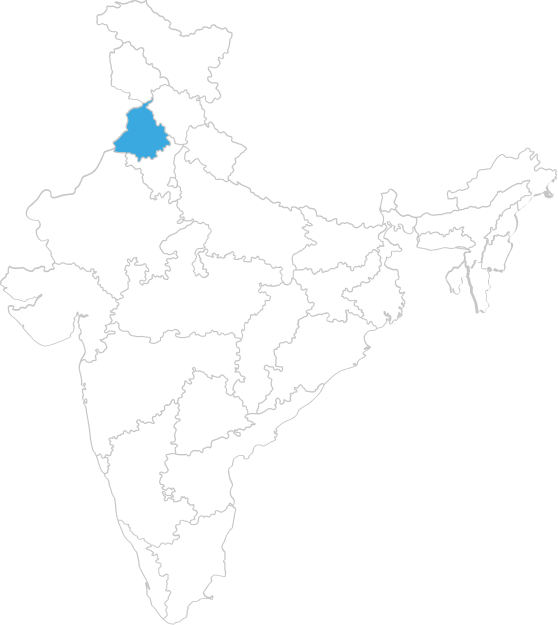
Expanding opportunity through Punjab's Schools of Eminence

Since 2022, we have partnered with the Department of School Education, Punjab, to support the School of Eminence (SoE) initiative, a flagship reform focused on academic excellence, career readiness, and holistic student development.

Today, the initiative reaches 45,000+ students across 128 Schools of Eminence, providing academic support, career guidance, mentoring, and preparation for competitive examinations such as IIT-JEE, NEET, CUET, and CLAT.

The programme has contributed to increasing student success in competitive examinations and admissions to premier institutions, while strengthening teacher capacity and improving access to digital learning resources.

Academic bootcamps, mentorship programmes, and exposure visits further help students explore higher education and career pathways. Growing public trust in government schools is reflected in the 2.3 lakh+ applications received for over 20,000 seats across Schools of Eminence.

Going forward, we aim to strengthen academic support systems, expand career readiness opportunities, and deepen district-level academic leadership across Punjab.

Scale of Work

Schools
Schools of Eminence supported
0
Students
Reached across Classes IX–XII
0 +
Applications
Received for SoE admissions
0 lakh+

Advancing NIPUN Bharat through system strengthening in Uttar Pradesh

Launched in 2022, STEP-UP (School Transformation and Empowerment Program) is implemented in partnership with the Department of Basic Education and SCERT Uttar Pradesh to advance the goals of the NIPUN Bharat Mission. Through the Super 150 initiative, the programme supports 150 Block Education Officers to strengthen academic leadership and drive school improvement across Uttar Pradesh.

The statewide Parent-Teacher Meeting (PTM) initiative has reached 1.33 lakh government schools and engaged more than 8.85 lakh parents, strengthening school-community partnerships.

Project-Based Learning (PBL) is being implemented in 1,729 schools for Grades 6–8, reaching 19,567 students, with plans to scale to 18,000+ middle schools across the state.

The Arunodaya Student-Led Morning Assembly Initiative was piloted in 52 schools in Varanasi, reaching 13,300+ students, and is now being prepared for statewide scale.

STEP-UP is also supporting the transformation of DIETs into Centres of Excellence across 27 districts.

Going forward, the partnership aims to deepen system integration and scale leadership development, experiential learning, and student-led initiatives across Uttar Pradesh.

Scale of Work

Schools
Reached through statewide initiatives
0 lakh+
Parents
Engaged through Parent-Teacher Meetings
0 lakh+
BEOs
Supported through Super 150
0
DIET Districts
Supported through Centres of Excellence
0

Strengthening system-led reform in Bihar

The partnership with the Government of Bihar began in 2020 with online teacher capacity-building during COVID-19 and has since expanded to support classroom practices and education leadership across the state.

Through initiatives such as Micro-Improvement Projects on DIKSHA, a statewide Reading Campaign that reached nearly 1 lakh teachers, and Bihar’s first structured Parent-Teacher Meeting in 2022, the work has strengthened teaching practices and engaged over 14 lakh parents in government primary schools.

The District Empowerment Programme (DEP), launched with SCERT and the Department of Research and Training, strengthened all 66 Teacher Education Institutes (TEIs) to support academic improvement across schools. The programme is now being transitioned to the state for independent implementation.

Project-Based Learning (PBL), launched in 2023 for Grades 6–8, has scaled across all 38 districts and 537 blocks. Starting with Science and expanding to Mathematics, it now reaches ~29,000 schools and 57.7 lakh students. Over 12,000 teachers have been trained, and students show an average learning gain of +8.84 percentage points in Maths and Science.

Alongside this, the Women Leadership Collective has created community-led platforms for engagement, with over 9,000 Shiksha Chaupals led by 510+ women leaders across 14 districts.

Scale of Work

Students
Reached through Project-Based Learning
0 lakh+
Education Leaders
Teacher Education Institutes strengthened through DEP
0
Chaupals
Community-led learning spaces across 14 districts
0 +

Transforming tribal education at scale in Odisha

Since 2023, we have served as the Program Management Unit (PMU) for the ST & SC Development, Minorities & Backward Classes Welfare Department, Government of Odisha, supporting one of India’s largest tribal education ecosystems with 1,700+ residential educational institutions and 5,800+ hostels.

We are implementing Project-Based Learning (PBL) for Grades 6–8 in 80 schools across four districts, reaching 8,000+ students and supporting 300+ teachers through experiential and contextualised learning.

We have enabled ecosystem innovations such as Building as Learning Aid (BaLA), which has transformed 106 schools into interactive learning spaces, and the Ecology Programme, which is being piloted in 18 schools to promote environmental learning.

Through the STEM Summer Camp initiative, children in tribal communities engage in hands-on STEM learning while rural youth take on leadership roles across 100 villages.

Going forward, we aim to expand experiential learning and build institutional capacity for long-term educational transformation across Odisha.

Scale of Work

Institutions
Residential educational institutions supported
0 +
Students
Reached through Project-Based Learning
0 +
Teachers
Supported through PBL implementation
0 +
Schools
Transformed through BaLA
0
Villages
Engaged through STEM Summer Camp
0

Parent-teacher meeting (PTM) data on the state app & dashboard in Telangana

The integration of PTM data and resources into the state’s existing app emerged From a strategic alignment with ongoing data capture initiatives. Concerns over potential user burden led to the decision to incorporate PTM-related features into the existing infrastructure rather than introduce a separate platform. This consolidation not only streamlined data collection but also enhanced accessibility For headmasters (HMs) and improved data accuracy. Prior reliance on manual reporting methods yielded inconsistent and unreliable data, highlighting the necessity for a more integrated solution. The successful implementation witnessed substantial parent engagement, with an average of 6.5 lakh attendees per meeting, underscoring the effectiveness of the revamped system in capturing and utilizing PTM data.

Project-based learning enhances student outcomes in Andhra Pradesh's backward classes welfare schools

In addition to Bihar, we implemented the PBL in Andhra Pradesh’s backward classes’ welfare residential and educational Institutions. We conducted a third-party assessment there through ConveGenius. This longitudinal study evaluated the effectiveness, impact, and sustainability of the PBL intervention. Using a difference-in-difference quasi-experimental design, it compared student learning outcomes and qualitative feedback from various stakeholders between treatment and comparison groups. Assessments were conducted in September 2023 and March 2024, involving 5,005 students of grades 6 and 7 for English and Math.

The difference-in-differences (DID) analysis showed that the treatment group consistently outperformed the comparison Group in both English and Math. The most significant growth was observed in grade 7 Math, with treatment improving by 49 Points compared to 28 for comparison, leading to a 35% increase in grade readiness versus 18%.

Schools
0 +
Teachers
0 +

Reimagining public education across Karnataka

In Karnataka, the partnership began in 2017 with a cluster transformation initiative in Anekal and has grown into one of the largest state partnerships, working across schools, districts, and the state education system.

At the centre of this work is Sachetana, implemented with Samagra Shikshana Karnataka and DSERT. The programme spans 204 blocks, 47,129 schools, supports 50,000+ education leaders, and reaches more than 35 lakh students. It focuses on student leadership and parent engagement, with over 80% of schools conducting student-led morning assemblies.

District initiatives complement this statewide work. Vidyadeepa in Bengaluru Urban South supports foundational literacy and numeracy across 1,330 primary schools. Samartha in the Kalaburagi Division works across four districts to strengthen school leadership and improve learning outcomes in high schools.

The Anekal Cluster Transformation Programme continues to serve as an innovation hub, piloting approaches in social-emotional learning, environmental education, sports, and reading. In Mysuru, STEM programmes are expanding hands-on learning opportunities in higher primary schools.

Across programmes, schools have reported stronger student participation, improved parental engagement, and better learning outcomes.

Going forward, the partnership aims to deepen future-ready learning, strengthen community engagement, and continue supporting system-wide educational reform across Karnataka.

Scale of Work

Students
Reached across programmes
0 lakh+
Schools
Engaged across Karnataka
0
Education Leaders
Supported through statewide and district initiatives
0 +
Blocks
Covered through Sachetana
0
Districts
Reached through Samartha in the Kalaburagi Division
0

For more information download our annual report

Journeys of Impact and Transformation

Discover personal stories from individuals and communities transformed by our initiatives. These powerful accounts showcase the significant impact of our efforts and the strength of collaboration in driving meaningful, lasting change.