

By Abhishek Jain, Head, Public Policy at Mantra4Change.
Introduction: Law and Policy as Tools for Social Change
Societies have relied on law and policy not only to regulate behavior but have also served as levers of transformation shaping progress, creating opportunities, correcting imbalances, and steering collective action.
In the contemporary context, law and policy can serve (among others) the dual functionality of enabling and directing. Serve as ‘enablers’ opening pathways and creating opportunities, and ‘drivers’ imposing obligations, nudging behavior, and directing collective effort.
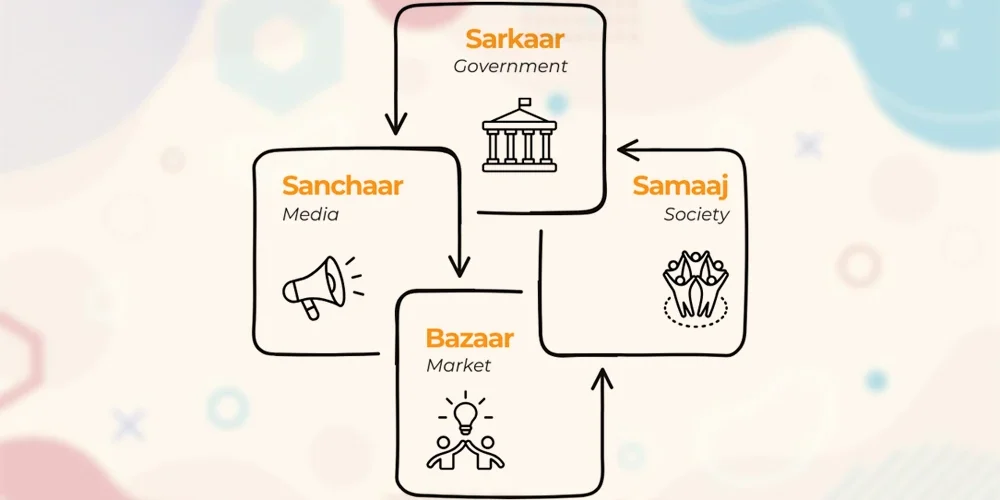
For system‑level reform, particularly in education, these roles must be anchored in four foundational pillars/forces:
| Pillar | Role in system level reform (in education) |
|---|---|
| Samaaj (society) | Civic participation and social demand for change, ensuring reforms reflect community needs and aspirations |
| Sarkaar (government) | Authority drafting and building laws and policies that govern us, providing the institutional backbone for reform. |
| Bazaar (market) | Economic forces and innovations that sustain reform, creating resources and scalable solutions for education delivery. |
| Sanchaar (media) | Communication channels that shape narratives and mobilize opinion, driving awareness and accountability around education policy. |
This blog explores some examples of how some central laws and policies act as enablers and drivers across these four pillars, and how this can enable and drive us to build a more robust education system and policy.
Role of Law and Policy as a Driver in the Education System
- Mandates for the government from the law of the land - the Constitution of India (“CoI”) also considered the law of the land prescribes the duty and obligations of the government in relation to the right to education. 5
- Mandates for public and private actors - the government through the legislature prescribes different laws and policies to regulate the end-to-end education delivery machinery, and also to drive different system actors to maximise their impact in the space. ‘Education’ is a subject over which the state retains ownership of law and policy making and both the Parliament (central level) and the Legislature of any State (state level) have the power to make laws and policies on.6
- Responsibilities of the parents/ guardians - the parent / guardian as the case may be, are required to enroll their children in a school to enable them to complete their compulsory elementary education.7
- Duty to undertake corporate social responsibility (“CSR”) - all companies “including its holding or subsidiary, and a foreign company …. having its branch office or project office in India”8, “having net worth of rupees five hundred crore or more, or turnover of rupees one thousand crore or more or a net profit of rupees five crore or more”9 are mandatorily required to undertake CSR activities which expressly include activities relating to “promoting education, including special education and employment enhancing vocation skills especially among children, women, elderly, and the differently abled and livelihood enhancement projects”.10
Role of Law and Policy as an Enabler in the Education System
- Decentralised decision making - different laws empower local institutions and authorities to adapt education delivery to contextual needs as relevant, ensuring that reforms are personalized to their needs and we do not follow a not one‑size‑fits‑all approach.
- Policies incentivising investment in education - different government policies at the center and state level incentivise investment in the education space, thereby mobilising private capital, expertise and innovation to strengthen the education system overall.
- Tools to drive transparency - to drive transparency in the education system and also to allow the polity to keep the government in check, the citizens have the right to seek information pursuant to their right to information, and further empowers citizens to seek corrective action through the support of the judiciary by filing public interest litigations. This transparency enables better alignment of resource allocation, budget priorities, and school infrastructure with actual needs.
- Driving meaningful dialogue and discourse - all “citizens shall have the right— to freedom of speech and expression”11 which empowers the citizens, press and media to carry out unbiased and free reporting to drive meaningful discourse with the polity at large. This ensures education is not confined to policy documents but becomes a subject of collective debate and action.
- Citizens' role in participatory democracy - India has institutionalized the concept of pre-legislative consultation thereby reflecting a move towards building a stronger participatory democracy.12 Now the government government is required to release “the draft legislation or at least the information that may inter alia include brief justification for such legislation, essential elements of the proposed legislation, its broad financial implications, and an estimated assessment of the impact of such legislation on environment, fundamental rights, lives and livelihoods of the concerned/affected people, etc” to the general public for public and stakeholder inputs for a period of at least 30 days.13 This empowers all citizens to directly influence the laws and policies that govern us, and allow different stakeholders practitioners in the education system to share their learnings and inputs from the ground to influence laws and policies.
Conclusion
It is pertinent to understand that the legal and policy framework are instrumental in the future of India’s education system. They enable and drive each pillar in different yet interconnected ways, not only ensuring that each of their roles and functions reinforces the others but also helping drive meaningful and impactful systemic change, collectively laying the foundation for an education system that is accessible, equitable, and future‑ready.
This vision resonates with the work of organisations like Shikshagraha, which seek to reimagine public education by restoring agency to schools and communities, proving that systemic reform is not only about laws and policies but also about people leading change on the ground.
Moving forward, the focus must be on strengthening laws and policies as both enablers and drivers of education reform, while ensuring that every stakeholder actively plays their role in shaping a system that truly delivers.
* By Abhishek Jain, Head, Public Policy at Mantra4Change.
* AI Use Declaration: Assistance of AI tools was taken for analysis and copy-editing of this blog.
1 The National Education Policy 2020 (‘NEP) was approved on July 29, 2020 and is accessible here.
2 Page 6 of the NEP.
3 Legal Scholar and Educator, who also served as the Dean of Harvard Law School from 1916–1936.
4 Pound, Roscoe, “The lawyer as a social engineer”, J. Pub. L. 3 (1954): 292.
5 You can read more about the mandates flowing from the law and policy framework, here- https://www.mantra4change.org/indias-education-policy-landscape/ and https://www.mantra4change.org/decoding-the-fundamental-right-to-education-in-india/
6 Article 246 and List III – Concurrent List of Schedule VII of the CoI; you can read more about the government’s power to prescribe law and policy here – https://www.mantra4change.org/indias-education-policy-landscape/
7 Article 51A(k) of the CoI.
8 Rule 3(1) of the Companies (Corporate Social Responsibility Policy) Rules, 2014.
9 Section 135 of the Companies Act, 2013.
10 Paragraph (ii) of the Schedule VIII of the Act.
11 Article 19(1)(a) of the CoI.
12 DO Letter, DO 11(35)/20-13-L.I, issued by the Legislative Department, Ministry of Law and Justice, dated February 5, 2014 (“Pre-Legislative Consultation Policy”).
13 Paragraph 2, Appendix, Pre-Legislative Consultation Policy.