
What NITI Aayog’s School Complex Reform Still Needs to Drive Meaningful Outcomes, not Just Implement

A policy analysis of NITI Aayog’s 2026 school complex recommendations, and the formal authority still missing from them India has largely solved the access problem in school education. Nearly 50% of school-going children attend one of over 10 lakh government-run schools, enrollment at the elementary stage is near universal,and basic infrastructure such as toilets, electricity,…

Why Reimagining Education for Future Readiness Is Critical to India’s Viksit Bharat 2047 Vision

Prime Minister Modi’s Viksit Bharat mission aims to make India a developed country by 2047. This goal is not just about economic growth. It means structural transformation across human capital, governance, and social institutions. Education is central to that transformation because it both transmits culture and prepares citizens for the demands of a changing global…

Decoding the Role of Law and Policy as Enablers and Drivers of Samaaj, Sarkaar, Bazaar, and Sanchaar in Building a Better Education System and Policy

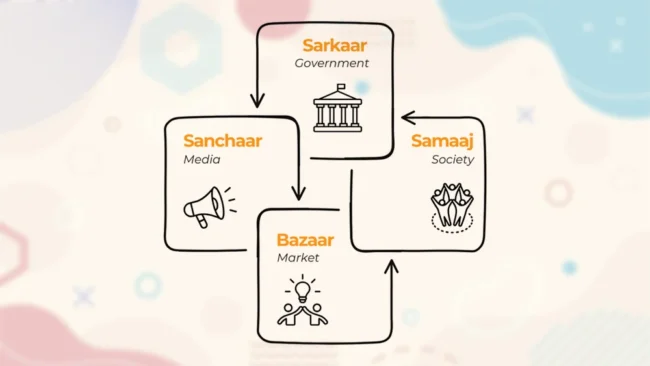
By Abhishek Jain, Head, Public Policy at Mantra4Change. Introduction: Law and Policy as Tools for Social Change Societies have relied on law and policy not only to regulate behavior but have also served as levers of transformation shaping progress, creating opportunities, correcting imbalances, and steering collective action. Nathan Roscoe Pound3 conceptualised law as social engineering.…

Mapping the Right to Elementary Education: A Comparative Lens across Instruments influencing Education Policy

By Abhishek Jain, Head, Public Policy at Mantra4Change. Though this piece we have conducted comparative mapping studies of the right to elementary education across the Universal Declaration of Human Rights (“UDHR”), International Covenant on Economic, Social and Cultural Rights, 1966 (“ICESCR”), the Convention on the Rights of the Child, 1989 (“CRC”), the Constitution of India…