

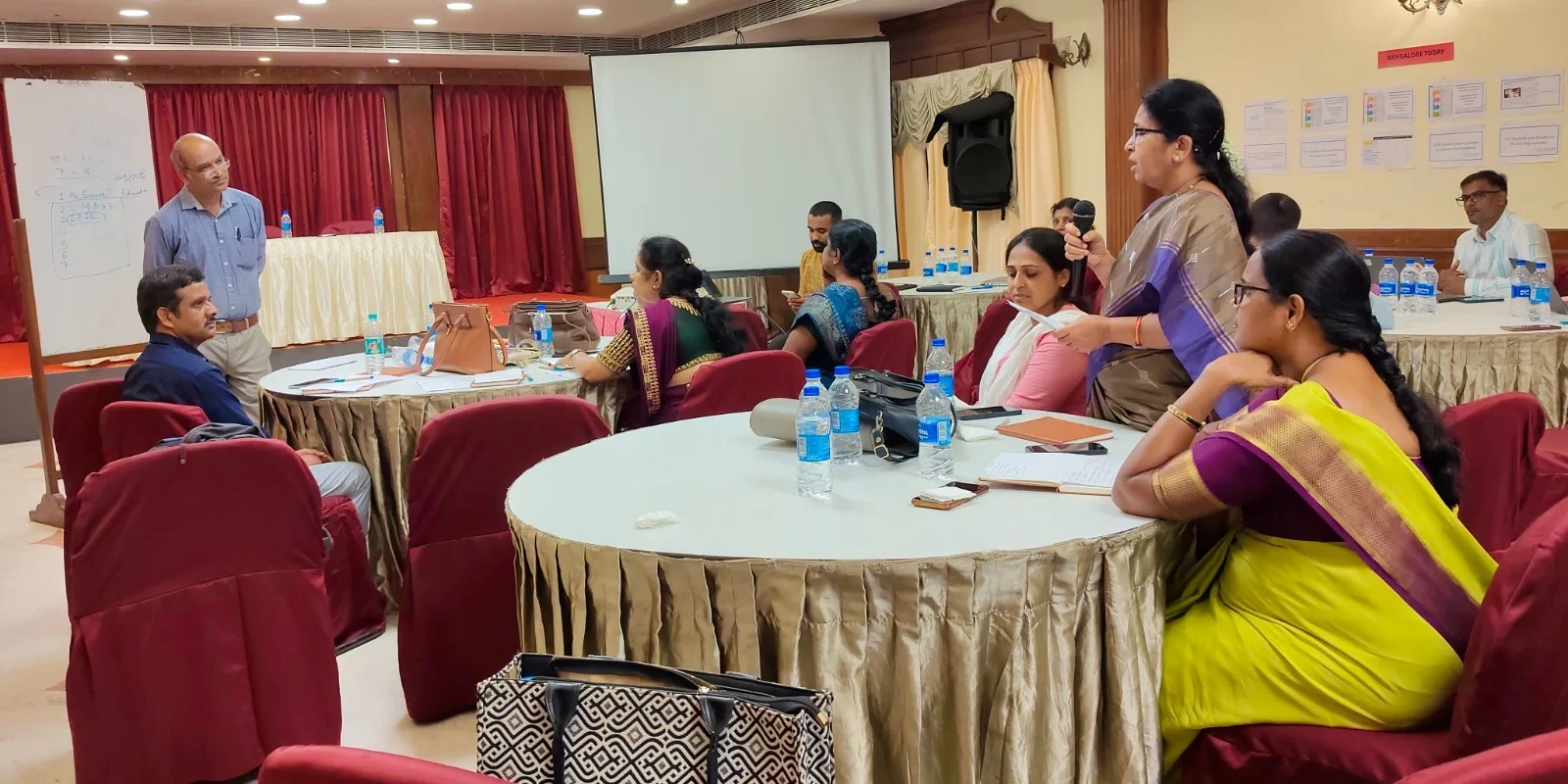
Lakshmi Lali speaking at a DIET workshop
“Writing this story was not just about sharing Lakshmi Ma’am’s journey. It also gave me a chance to understand her work more closely. Through our conversations, I learned so much about her dedication and about the work she does within DIET and among the schools she works with.”
— Naveen, Program Lead, Mantra4Change
There are days when the work in schools feels heavy. A meeting that does not go as planned, a change that takes longer than expected. On those days we are reminded where our strength actually comes from. It comes not just from within, but also from our stakeholders, the people who stand with us every step of the way.
Presenting the story of Lakshmi Lali. At District Institute of Education and Training (DIET) Bangalore Urban, some names come up in almost every conversation, and hers is one of them. Her support has helped shape Vidyadeepa, a programme focused on strengthening school and system level practices to improve learning outcomes in Karnataka.
Lakshmi Ma’am has always loved teaching.
It began long ago, in her early days as a high school teacher. Somewhere in those first years, standing before a room full of restless children, she learned something she has never let go of.
Real change is never handed down from behind a desk. It is built in the classroom, face to face, in the everyday work of showing up for your students.
That belief has carried her through 12 years of teaching D.Ed. and D.L.Ed students. But somewhere along the way, she discovered a joy even deeper than teaching itself: watching young teachers grow into good educators.
Even today, that same instinct pulls her back to the schools. She visits often, sitting with teachers over lesson plans and documentation, not just to guide them, but to simply be present, to see for herself how much students are truly learning.
A Vision Shaped Early in Life
Lakshmi Ma’am’s story begins in Kustagi, a small village in Koppal Taluk of Bagalkote District, Karnataka. Growing up there, she saw, up close, the challenges girls around her faced simply because they were girls.
“Back then, many families didn’t really know how far education could take their daughters,” Lakshmi Ma’am recalls. “Resources were limited, and old traditions ran deep, so it was common for girls to be married off early instead of continuing their studies.”
“And it wasn’t only about awareness,” she adds. “Most of the schools around us taught only in Kannada. English medium schools were hard to find in villages back then. That made it tougher for us, later, to compete with kids from the cities when it came to jobs and opportunities.”
She believes that every child, no matter where they come from, deserves quality education and a genuine shot at success.
A Responsibility She Took On
For Lakshmi Ma’am, teaching teachers well is only half the job done. The real test, she believes, is simpler and harder: can you see that training reflected in how a child actually learns in the classroom?
As the Nodal Officer for Pre-Service Teacher Education (PSTE), she works closely with teacher training institutions, helping them shape how new teachers are taught, from classroom methods to real, hands-on teaching practice. Alongside this, she personally mentors 8 schools, staying in regular touch, following up, and guiding them step by step.
“Many children could not read, write, or explain things the way they should for their grade,” she shares. “When I asked what they had learnt, they would tell me what they had heard, or what they imagined, not what they truly understood.”
“I never really had one person I could call my mentor,” she says, thinking back. “I had so many people around me to learn from. I used to watch the way leaders at the state and district level worked together, how they planned things and brought in new ideas for every part of DIET. I didn’t realise it then, but all that watching stayed with me. It also shaped the way I work even today.”
A Solution Rooted in Collaboration
To close the learning gaps she had seen, Lakshmi Lali had one clear goal in mind: to improve PARAKH learning outcomes grade by grade and build stronger basics for every student.
Performance Assessment, Review, and Analysis of Knowledge for Holistic Development (PARAKH) is India’s national assessment regulator, set up under the National Council of Educational Research and Training (NCERT). Created as part of the National Education Policy (NEP) 2020, it sets common standards for student evaluation across state and central boards.
She believed this could only work if all wings of DIET came together to design and carry out the program as one team.Performance Assessment, Review, and Analysis of Knowledge for Holistic Development
Her plan included baseline and endline assessments to track real progress, along with resource curation and capacity building for block-level officials and teachers. She also placed strong importance on classroom observation, data-based monitoring, and continuous evaluation to make sure the program stayed on track. And beyond the numbers, she made space for something just as important: documenting success stories, appreciating teachers for their efforts, and celebrating every achievement along the way, big or small.
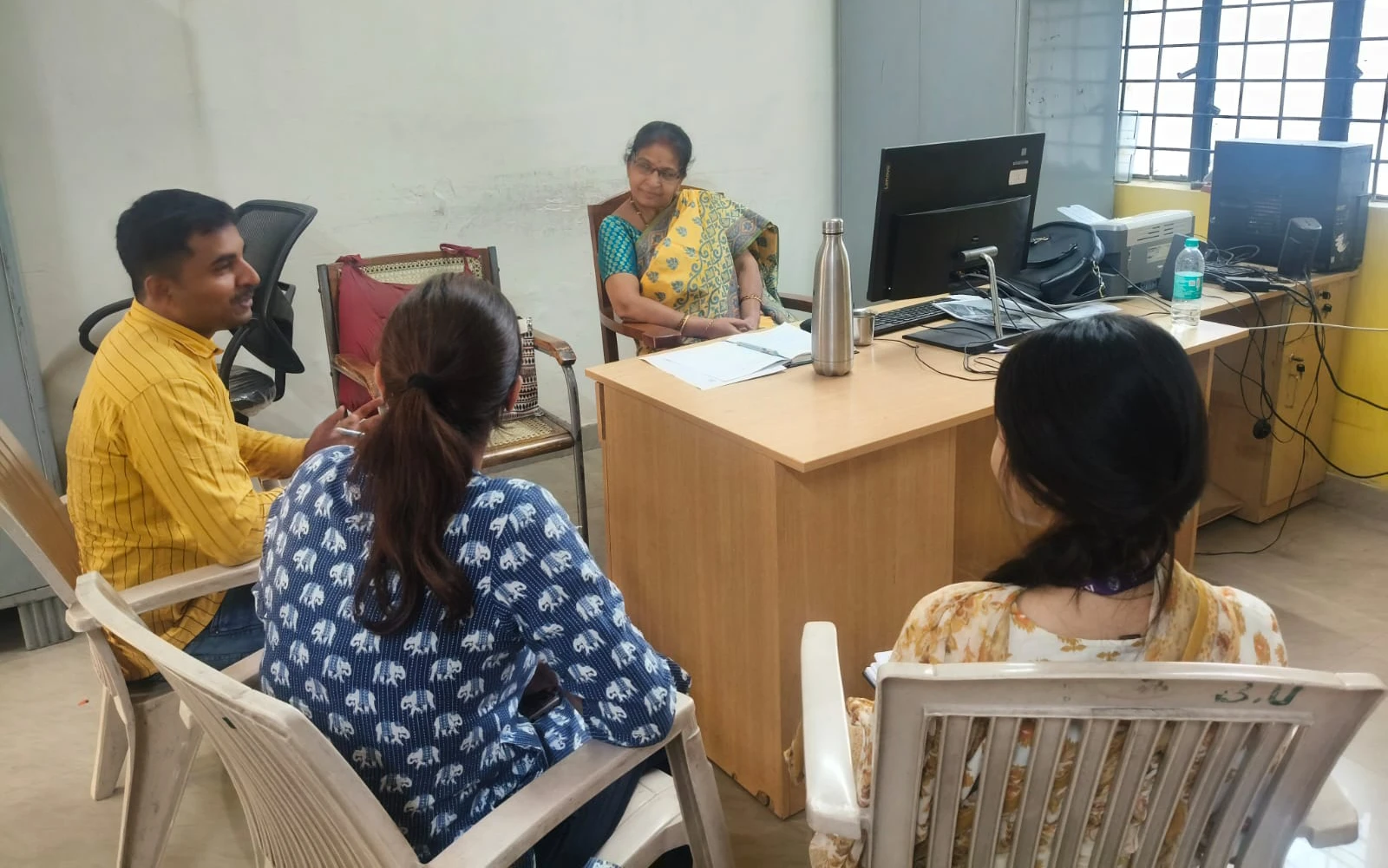
Naveen Kumar D M, District Program Lead, in conversation with Lakshmi Lali
The Change She Brought
Her work brought a more structured, collaborative culture to DIET. Different wings began working together rather than separately, sharing both planning and responsibility for academic programs.She also played an important role in creating and strengthening district-level resource groups, which now support capacity building and academic mentoring across schools.
Archana, Program Lead for the Bangalore team, shares:
“From day one, Lakshmi Ma’am has been someone we could always turn to. Whatever the doubt, whether about PTMs, school leaders, or working with parents, she always has a clear, practical answer ready. What I admire most is her attention to detail, right down to the smallest things, a study timetable, how a reading corner is set up, small touches that quietly make a big difference.
She also brings such clarity to how things should work: what a teacher’s role should look like, how parents and teachers should stay connected, and how students themselves can be more involved in their own learning. That’s what makes working with her so dependable, she shows up the same way, every single time.”.
A Partnership That Made a Difference
“Working with Mantra was never difficult, it made things easier for all of us,” she says. “The team supported us in building good educational resources and putting proper systems in place to reach schools better. For me, this kind of partnership helped DIET sharpen its vision and support our schools and officials in a much better way.”
Over nearly two years, this collaboration helped DIET co-design and carry out academic initiatives at both the block and district levels, through capacity building, vision development, mentoring, and resource support. Programmes like PTM initiatives and effective morning assemblies came to life through this same joint planning.
Today, Lakshmi Ma’am can see that vision slowly turning into something real, and it shows up in the smallest places:
“What makes me really happy is seeing our Head Teachers and teachers come forward through the Pragathi Hejje Programme. They share their own small innovations, best practices from the classroom. When I see that, I feel our vision for Vidyadeepa is actually happening.”
Perhaps that is why her answer comes so easily when asked what she would say to a young girl in a Karnataka school today:
“You should pursue education because it empowers you to become socially, economically, and morally responsible, helps you lead a self-reliant life, and enables you to live with dignity and earn respect in society.”
It is, in many ways, the same message she carried with her from her own village all those years ago. Now she is making sure it finds every child in time.