

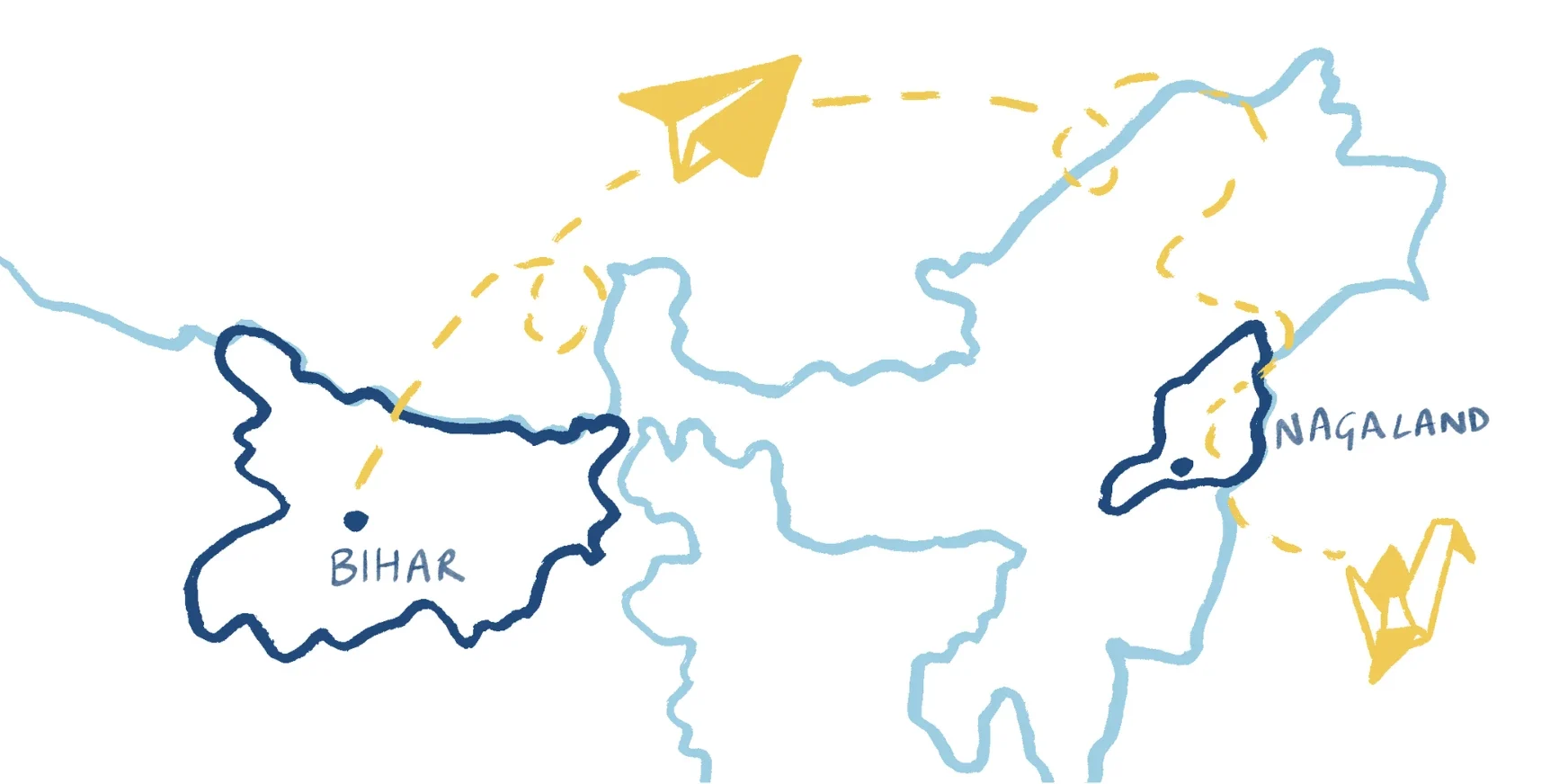
If I design a programme keeping two people in mind, say, A and B, can I implement the same programme for two completely different people?
Maybe.
But what happens when I take the same programme and implement it for two hundred people? Two thousand? Two hundred thousand?
At some point, the question stops being simply about whether the programme can be made bigger.
It becomes a question of whether something designed for one context can travel to another without losing what made it work in the first place.
And this is where I think our understanding of scale needs to become a little more complicated.
We often talk about scaling an intervention as though scale simply means increasing its size: more classrooms, more teachers, more children, more schools, more organisations. But there are different ways in which something can scale. Scale can be understood through reach (who experiences an intervention), influence (who changes because of it), and propagation (who carries its core idea forward into their own practices).
The third kind of scale asks a different question.
Not: How many people did we reach?
But: How many people can make this idea work without us being there?
Consider Project-Based Learning (PBL), one of our initiatives, which was first implemented in 2023. Since then, it has expanded across 6 states in India. But scaling PBL has never meant replicating the same classroom programme across thousands of schools. In Bihar, for instance, a student’s interest in cricket became the starting point for exploring mathematics. Through a project that brought cricket scores and study goals together, Sabrin Khatoon worked with numbers in a context she could relate to, while also challenging the idea that cricket was only for boys. In Nagaland, the patterns of traditional Naga shawls became a way to understand fractions, with students translating mathematical calculations into shapes and designs. The underlying concepts remained the same, but the ways of exploring them changed. This is what designing for scale looks like: not standardising the learning experience, but creating an approach flexible enough to make learning meaningful across different classrooms and communities.
If the programme changes as it moves from Bihar to Nagaland, or from one school to another, what exactly is being scaled? The intervention itself does not need to become larger. What needs to scale is the structure through which its effect travels.
How does an intervention become infrastructure?
A research paper is infrastructure for knowledge transmission.
A toolkit is infrastructure.
Curriculum is infrastructure.
A teacher-training programme is infrastructure.
A policy is infrastructure.
A network is infrastructure.
They are very different things, but they share one important characteristic: they allow something to move beyond the context in which it was originally produced. For example, a curriculum allows a particular understanding of learning to travel between classrooms.
So perhaps designing for scale is not primarily about designing a bigger intervention.
It is about designing the mechanisms through which an intervention can travel.
Instead of asking: How do we make this intervention bigger?
we can ask: What would allow the effect of this intervention to travel?
And this is where transferability becomes important because it creates the possibility for propagation. A transferable intervention is one whose underlying logic can be understood, adapted and reconstructed by someone else.
Why does the form travel but the logic does not?
Imagine that I observe a teacher using a particular PBL activity and I train another teacher to conduct exactly the same activity.
Have I scaled PBL? I may have replicated an activity. But I have not necessarily transferred the logic behind the activity.
The second teacher might reproduce the steps perfectly without understanding why those steps matter. The activity might work beautifully in one classroom and fail completely in another. This is because the visible form of an intervention is not necessarily the thing that makes it effective.
In Zen and the Art of Motorcycle Maintenance (1974), a philosophical novel exploring the relationship between quality, craftsmanship, and the way we approach our work, Robert M. Pirsig questions what happens when we change the structures around us without questioning the thinking that created them in the first place.
He says, “If a factory is torn down but the rationality which produced it is left standing, then that rationality will simply produce another factory.”
The important distinction here is between what is visible and what is generative. A factory is visible. The rationality that produced the factory is less visible. An educational activity is visible. The assumptions, relationships, decisions and principles that produced that activity are less visible.
If we replicate only the visible form, we may reproduce the intervention without reproducing the conditions that made it meaningful.
So what needs to travel is not the activity itself, but the logic that makes the activity work. And that logic may be distributed across many parts of the intervention.
What makes something transferable?
An educational intervention is not simply its lesson plan.
Its structure might include: what learners make or do; how the teacher facilitates learning; what kinds of questions are asked; how learning is assessed; what resources are required; and what the intervention is ultimately trying to change.
Some of these are components. But the more interesting part may be the relationships between the components.
For example: If a child encounters P, the teacher does Q, which creates an opportunity for R kind of learning, which is then recognised through S.
That relationship is part of the intervention’s structure.
And perhaps this is what makes something transferable: not that every component can be copied, but that someone else can understand how the components work together well enough to reconstruct them in a different context.
This means that a good toolkit for scale may not simply tell a teacher: “Do this.”
It might instead help the teacher understand: “This is what we are trying to achieve. These are the principles that matter. These are the things that cannot be compromised. These are the things you can change. And this is how you might know whether your adaptation is still achieving the intended purpose.”
A is not B
And this brings us back to A and B.
A is not B.
The classroom in Delhi is not the classroom in Bangalore. One teacher is not another teacher. One school does not have the same resources, culture, relationships or constraints as another.
How much of an intervention needs to remain fixed for it to remain the same intervention? And how much can change before the thing being transferred becomes something entirely different?
We are trying to hold two seemingly contradictory things at once: consistency and difference.
If everything is fixed, we may produce standardisation without relevance. If everything is flexible, we may lose the intervention itself.
The challenge is to design something that can change form without losing purpose.
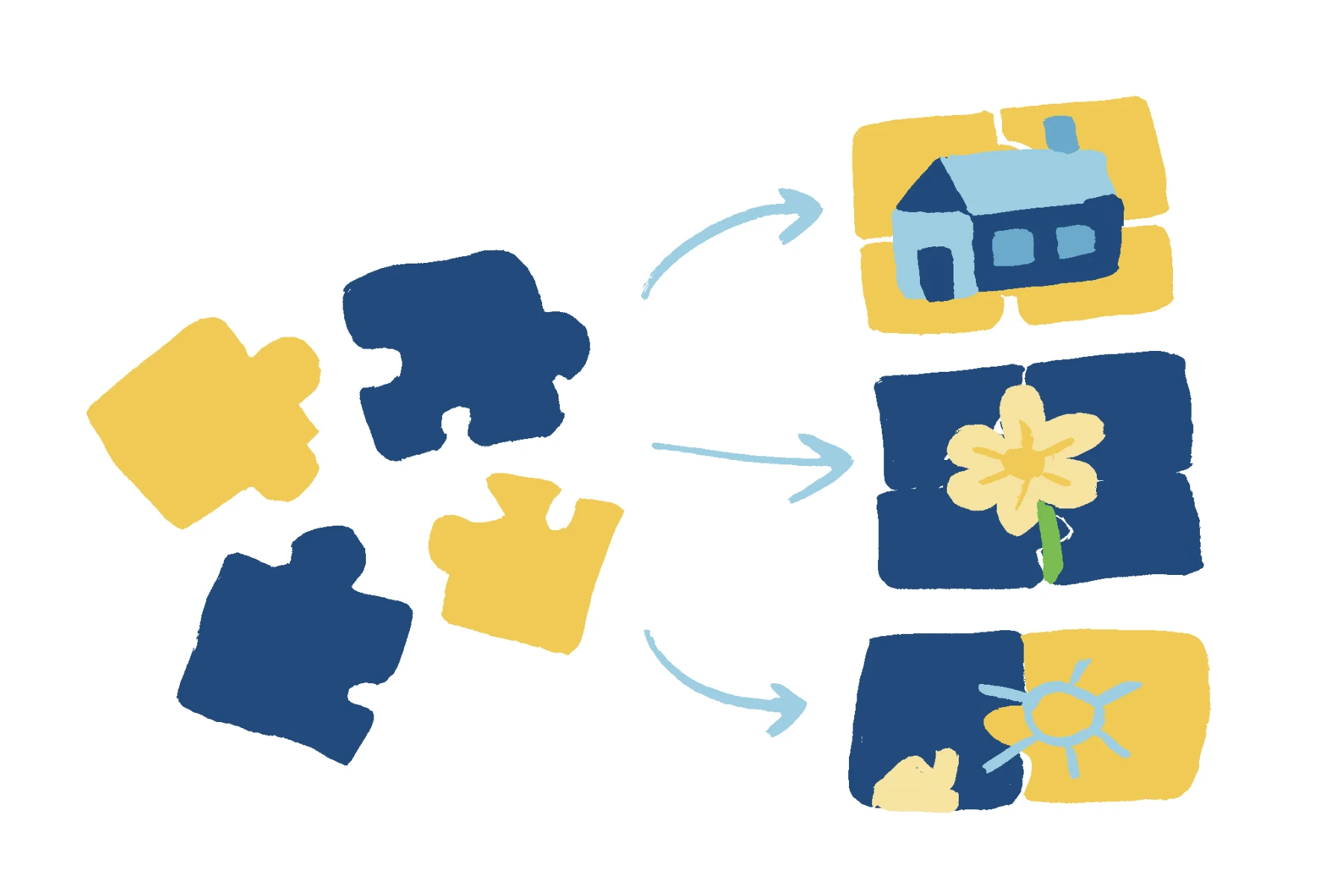
What happens when a puzzle doesn't have just one picture?
Designing for scale feels like solving a strange puzzle. The pieces need to work together, but they may not produce the same picture everywhere.
That is not a failure because we may have assumed that there is supposed to be one picture. A traditional puzzle asks us to reconstruct an image but designing for transferability may require something closer to a system of parts: pieces whose relationships and principles are understood well enough that they can be recombined differently in different places.
The goal is therefore not: “Can someone recreate exactly what we did?”
It is: “Can someone else use what we know to create something that works here?”
That is a fundamentally different design question.
What does it mean to design for scale?
Perhaps designing for scale is not about asking: How can we make one thing work for everyone?
That question assumes that everyone needs the same thing.
Perhaps the better question is: How can we design something that can become many things without losing what made it valuable in the first place?
This also changes what we mean by success.
A successful intervention at scale may not be one that looks identical in every classroom.
It might be one where a teacher in Bihar, another in Nagaland and another somewhere else make very different choices but those choices are still guided by the same underlying principles.
The intervention has changed. The logic has travelled.
And perhaps that is what transferability really means. Not making the same thing happen everywhere. But designing the conditions that allow an idea, principle or way of working to travel, while giving it enough room to become locally meaningful.
References:
Varghese, Sharon. What Naga Shawls and Kick Fighting Can Teach Us About Mathematics: Exploring Project-Based Learning in Nagaland. Mantra4Change, 11 Nov 2025 https://www.mantra4change.org/blogs/what-naga-shawls-and-kick-fighting-can-teach-us-about-mathematics-exploring-project-based-learning-in-nagaland/
Mantra4Change. LinkedIn post. https://www.linkedin.com/feed/update/urn:li:activity:7346122975135309824/
Pirsig, Robert M. Zen and the Art of Motorcycle Maintenance: An Inquiry Into Values. 1974. [Online version]. [https://archive.org/details/zenandtheartofmotorcyclemaintenancerobertpirsigm._833_V/page/99/mode/2up] p. 100